A Derate Happens in Stages, Not All at Once
Nobody wakes up planning to lose power on the highway. But a DPF problem rarely skips straight to a derate without warning first. It builds in stages. And knowing what each one looks like is what separates a quick fix from a call for Wilkes-Barre semi recovery. We have been answering calls like that since 1945, long enough to see the same pattern play out more times than we can count.
Breaking the process into stages makes it a lot easier to catch early, instead of waiting until a truck is stuck on the shoulder. Most drivers only learn the difference between the stages after living through one of them, usually on a route far from home with a load still waiting to be delivered.

Stage One: The Warning You Can Still Fix
The first stage is usually just a dashboard light, sometimes paired with a note to service the emissions system. At this point, soot has built up faster than the truck’s regeneration cycles can clear it, often because of short trips, heavy idling, or stop-and-go routes that never generate enough exhaust heat.
This is the easiest and cheapest stage to deal with. A highway run long enough to trigger regeneration, or a trip to a shop if the light does not clear on its own, is usually all it takes to avoid the next stage entirely. Waiting a few more days rarely saves any real time once the second stage sets in.
Stage Two: The Derate You Can’t Ignore
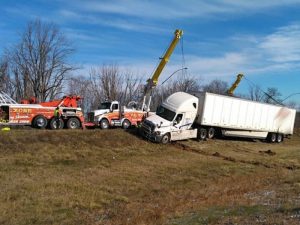
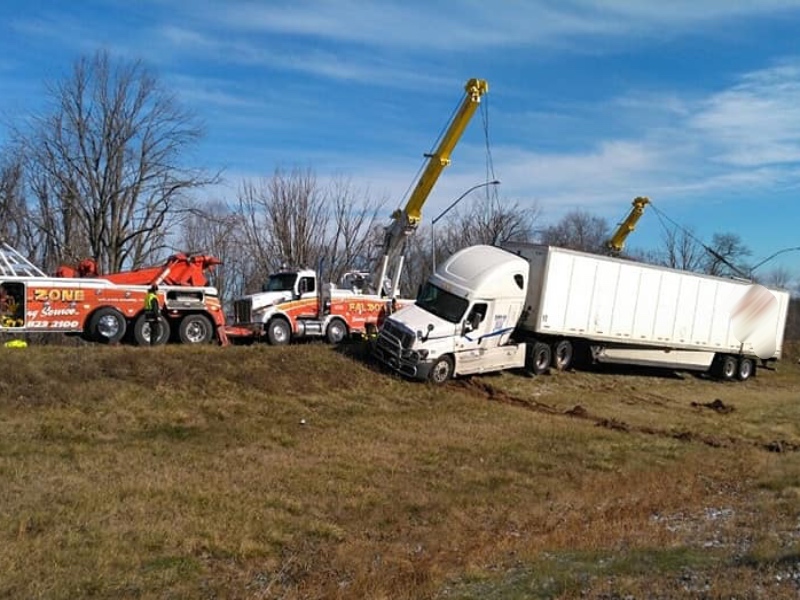
If the warning gets pushed aside long enough, the truck’s computer forces the issue by cutting engine power and top speed, which is exactly the point where a routine trip turns into a call for Wilkes-Barre semi recovery. That stage is usually recognized by a few clear signs:
- Noticeably reduced acceleration and a capped top speed
- A more urgent or steady warning light instead of an occasional flicker
- Rougher idle and lower fuel economy than normal
Pushing through a derate instead of pulling over rarely helps, and it is usually what turns a manageable problem into a call for semi recovery near Wilkes-Barre.
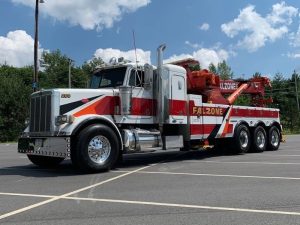
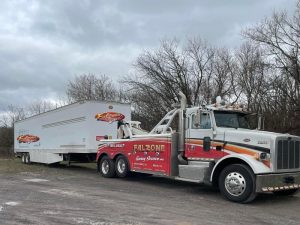
Falzone Towing: Wilkes-Barre Semi Recovery for Nearly 80 Years
Falzone’s grew from a small automobile service station in 1945 into one of the largest complete towing and service organizations in the northeast, and that growth came from treating every job, big or small, with the same attention, from a flat tire to a full Wilkes-Barre semi recovery. Our trained and experienced staff answers every Wilkes-Barre semi recovery call day or night, 24 hours a day, 365 days a year.
We have diversified over more than 70 years because the word “service” matters to us as much as the word “towing” does. That same approach is what customers get on every Wilkes-Barre semi recovery call, from something simple to a job that takes specialized transport to handle.
FAQs
Can a DPF warning light clear on its own?
Sometimes. If the truck completes a successful regeneration, the warning may clear. If it stays on or returns often, the system should be checked.
What is the difference between a warning light and a derate?
A warning light tells the driver the emissions system needs attention. A derate goes further by limiting engine power, speed, or RPM.
Can long highway driving help a DPF problem?
It can help some trucks complete regeneration by creating enough exhaust heat. The exact requirements depend on the engine and emissions system.
Why does stop-and-go driving make DPF issues worse?
Frequent low-speed driving can keep exhaust temperatures too low for normal regeneration. That allows soot to build up faster inside the filter.
Is rough idling always caused by the DPF?
No. Rough idle can have several causes. If it appears with DPF or emissions warnings, the truck should be diagnosed rather than assuming the filter is the only problem.
What should a driver do if the truck enters derate on the highway?
Move to an appropriate stopping location if possible and check the dashboard warnings. Continuing to push the truck can leave you with fewer options if the restriction becomes more severe.