Police Run the Scene Until They Hand It Over
Accident scenes are always complex. Emotions run high. Lanes are blocked. Flashing lights. When we arrive at a crash, the officer controls the area. They decide when photos are finished, when statements are done, and when the vehicles can be moved. On Drums accident recovery calls, we do our very best to cut through the complexity and help the first responders to their jobs.
Knowing When to Move
We do not hook up a car just because we are there. If the trooper needs another ten minutes to finish paperwork or check registration, it takes another ten minutes. Our job starts when they clear us to work.
That handoff can happen fast or slow depending on the situation. A fender bender with no injuries might take five minutes. A collision with airbags deployed, fluids on the pavement, or questions about fault can take longer. We stay ready and out of the way until the officer gives the word.
What We Check Before We Hook Up
Once we get clearance, we walk the vehicle. We look at the damage, the angle it is sitting, whether the wheels turn, and if anything is leaking. A car with a crushed front end loads differently than one with rear-end damage. A truck with a snapped axle needs a flatbed, not a wheel lift.
We also check the ground. Debris, broken glass, and fluid spills can create hazards for other drivers or make it harder to position the wrecker. On some Drums accident recovery calls, we sweep or move debris after loading. On others, the fire crew or highway crew handles it. That depends on what the officer decides and how much traffic is stacking up behind the scene.
Heavy Calls Need More Planning
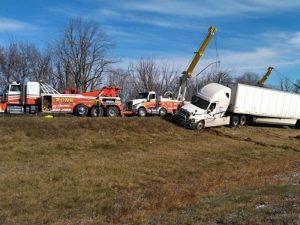
A sedan tow might need one truck and fifteen minutes, but a box truck rollover or a tractor-trailer across two lanes brings a bigger response. Fire crews may handle spills, police may close lanes, and we may need a heavy wrecker, rotator, or second truck before anything moves. On Drums accident recovery calls along Interstate 81, those scenes take time because traffic control, rigging, weight, and the final drop location all have to line up. Rushing that work creates more problems than it solves.
What Happens After the Vehicle Leaves
Once the car or truck is loaded, we take it where the officer directed. That might be our yard or a repair shop. If it is a crash tow and the driver arranged their own destination, we confirm that with the officer before we leave. On Drums accident recovery calls tied to arrests or abandoned vehicles, the destination is usually our facility until the legal side gets sorted out.
We also provide the driver or owner with paperwork showing where the vehicle went, what time it was towed, and how to retrieve it. That information matters when insurance companies, lawyers, or the vehicle owner start asking questions days later. Clear records prevent confusion and wasted trips to the wrong lot.
Falzone Towing Handles Drums Accident Recovery With Law Enforcement Across Northeast Pennsylvania
Falzone’s started as a small service station in 1945 and grew into one of the largest towing and recovery operations in the northeast. We have been working with state police, local departments, and fire crews for decades. Our team trains on light-duty towing, heavy recovery, and the coordination required when multiple agencies respond to the same scene.
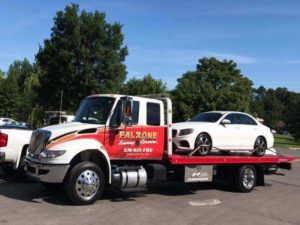
Our Drums accident recovery service covers Routes 309, 11, and Interstate 81, along with local roads. We run flatbeds, wheel lifts, heavy wreckers, and rotators depending on what the call requires. When an officer requests a tow, they know our Drums accident recovery team will show up prepared to handle the scene without adding complications. For us, the best calls are the ones where dispatch, police, and our operators stay on the same page from arrival to final drop-off. That keeps the road moving and gives the driver a clear next step after a stressful situation.
FAQs
Can police order a tow after a crash?
Yes. Police can request a tow if a vehicle is blocking traffic, damaged, unsafe to drive, or tied to an arrest or investigation. The officer decides what needs to happen next.
Why can’t the tow truck move my car right away?
The officer may still need photos, statements, registration checks, or paperwork. Tow operators wait until the vehicle is cleared before loading it.
Where does my vehicle go after a police tow?
It may go to an impound lot, storage yard, repair shop, or another approved location. The destination depends on the officer’s instructions and the type of call.
Can I get my belongings before the vehicle is towed?
Sometimes. The officer on scene decides if it is allowed. Traffic, safety, evidence, or an arrest can affect that answer.
Why would a crash tow need a heavy wrecker?
A heavy wrecker may be needed for box trucks, tractor-trailers, rollovers, or vehicles with major damage. Weight, position, and road access all matter.
What paperwork do I need to retrieve an impounded vehicle?
You usually need identification, proof of ownership, insurance information, and any release form required by the agency. Calling the storage lot first can save time.