
Weight, Speed, and the Road Between Them
The Pennsylvania Turnpike carries heavy commercial traffic year-round, and those of us in Pennsylvania Turnpike semi towing see what happens when that traffic meets the wrong conditions. A tractor-trailer rollover is among the most serious events on any highway, capable of blocking all lanes and posing real risk to every driver nearby. The forces that cause a rig to tip aren’t mysterious, but they add up fast when conditions line up.
We see these incidents at curve exits, at the base of grades, and on ramps that look manageable until they aren’t. Understanding what actually causes a rollover moves the conversation from bad luck to a set of factors that drivers and carriers can address before the wheels ever leave the pavement.
The Forces That Tip a Rig
A tractor-trailer rolls over when lateral forces exceed the truck‘s ability to stay upright, and while every vehicle faces this in a turn, the scale of a loaded semi leaves far less margin. A high center of gravity works against stability every time the rig changes direction, and a fully loaded trailer amplifies that effect.
Speed is the most direct factor. Lateral force increases with the square of velocity, so a driver going ten miles per hour too fast through a curve is significantly more vulnerable than the numbers suggest. Load height, suspension condition, and road banking all shape the outcome, but speed is the variable a driver controls in real time.
Shifting or Improperly Secured Cargo
Cargo that moves during transit raises the effective center of gravity and shifts weight to one side of the trailer. A load stable at departure can be a different situation after several hundred miles of vibration and lane changes. Bulk liquids are especially prone to surge, but even palletized freight shifts if it isn’t properly blocked and braced. The result is a trailer that reacts unpredictably when the driver steers or brakes.
Ramp and Curve Speed Underestimation
Advisory speed signs on ramps are calculated for passenger vehicles, not loaded commercial trucks whose center of gravity sits several feet higher. A ramp a car handles at the posted speed may require a semi to enter at significantly less. After hours of high-speed highway driving, fatigued drivers often carry that momentum into a ramp without adjusting, which is one of the more consistent factors in rollover incidents.
Practices That Reduce the Risk
Prevention is built into habits before and during a run. Drivers who avoid rollovers consistently tend to do the following:
- Inspect cargo securement at every pre-trip, including blocking, bracing, and tie-downs
- Check load distribution for even weight across axles before departure
- Enter loaded ramps at least 10 mph below the posted advisory speed
- Watch for fatigue and stop before it affects judgment behind the wheel
- Slow well in advance of curves rather than braking through them
Carriers carry responsibility here too. Unrealistic delivery schedules push drivers to hold highway speed longer than conditions allow. Route planning that identifies high-risk ramps and grades, combined with realistic dispatch expectations, addresses rollover risk at the organizational level.
When a Rollover Calls for Recovery
A tractor-trailer on its side is a multi-agency event. Heavy towing following a rollover requires heavy-lift equipment, rotators, and a carefully planned uprighting sequence to avoid worsening cargo loss or structural damage to the rig. Our towing crews assess the load, trailer position, and any hazardous materials present before a single line is attached.
Clearance time depends on the scene. Pennsylvania Turnpike semi towing after a rollover with spilled freight can mean hours of coordinated work between our tow crew, the carrier, and law enforcement. But as an experienced team, we know how to move through that process efficiently without cutting corners.
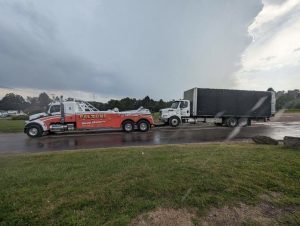
Falzone Towing: Pennsylvania Turnpike Semi Towing Built for Commercial Recovery
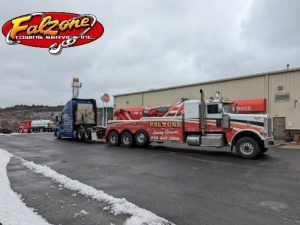
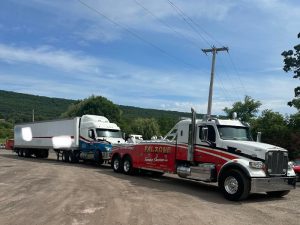
At Falzone Towing, Pennsylvania Turnpike semi towing is a core part of our operation. The Turnpike sees constant heavy commercial traffic, and our crews run heavy wreckers and rotator units because the work demands it. We’re equipped and trained for complex commercial recovery, including the uprighting and load recovery that follow a rollover.
Pennsylvania Turnpike semi towing means experience reading a scene, coordinating with carriers and law enforcement, and executing a recovery that gets the road open without creating new problems. Falzone Towing brings that level of experience to every call on this corridor. When you need Pennsylvania Turnpike semi towing, we’re the crew to reach.
FAQ
What types of cargo make a semi more likely to roll over?
High-density loads stacked tall, bulk liquids in partially filled tanks, and anything that shifts in transit all raise rollover risk. The common thread is a change in where the weight sits relative to the trailer’s axles, which raises the center of gravity and reduces lateral stability.
Can a driver feel a rollover starting before it happens?
Sometimes. A trailer that begins to lean excessively in a curve, a steering wheel that pulls toward the outside of a turn, or a trailer that feels “light” over its axles are all signals that something is off. Experienced drivers recognize these sensations and respond by easing off the throttle and straightening out rather than correcting with a hard steer.
How does electronic stability control help prevent truck rollovers?
ESC systems monitor lateral acceleration and automatically apply braking to individual wheels when the sensors detect the truck is approaching its tipping threshold. The system acts faster than a driver can react and can reduce rollover risk significantly on trucks where it’s installed and properly maintained.
Are tanker trucks more likely to roll over than dry van trailers?
Generally, yes. A tanker carrying a partial liquid load has a high, shifting center of gravity because the liquid surges and sloshes during braking and cornering. A dry van with properly secured, evenly distributed cargo behaves more predictably. Tanker drivers receive additional training specifically because of these dynamics.
Does truck suspension condition affect rollover risk?
It does. Worn or unbalanced air suspension can cause a trailer to lean more than it should in a turn, effectively lowering the threshold at which rollover becomes likely. Regular suspension inspections and timely maintenance are part of a complete rollover prevention approach.
What road features create the most rollover risk for loaded semis?
Freeway off-ramps with tight radius curves, downhill grades that feed into curves, and roads with significant crossfall or negative banking are consistently the most dangerous. These are the locations where advisory speed signs matter most and where a driver’s margin for error is smallest.